«Think of your ears as eyes.» — Keith Jarrett1
How It Works
If music is the art of sounds, ear training is the training of the musical ear. What do we mean by musical ear? Hearing has a more obvious passive aspect that consists in the ability to recognize sounds, but it also has an active aspect in which the musician improvises a phrase and is instantly able to produce it on their instrument.
But we'll talk about this later. For now let's go back to sound. Its characteristics are:
- pitch
- duration
- volume
- timbre
A body, once struck, produces a vibration that, setting the surrounding air in motion, reaches us. The outer ear channels the vibrations into the auditory canal where the eardrum forwards these movements to the inner ear. Here, the cochlea, a complex mechanical/hydraulic system, through hair cells, translates the vibrations into nerve impulses that are finally interpreted by the brain to generate the familiar sensation of hearing.
If we went into the details of the auditory process, we would immediately encounter the complexity and cognitive limits of scientific analysis. The most fascinating and mysterious aspect of hearing, however, remains the place of its manifestation: consciousness.
For us human beings, consciousness is taken for granted. We wake up in the morning and find ourselves immersed in a subjective first-person experience, as if we were in a multimedia 3D cinema with surround audio. But where is the screen on which the image we have in front of our eyes is projected? Where is the inner voice reading these words right now? Well, we don't know yet.
David Chalmers illustrates the problem of consciousness very well in this video. Of course there are also those who, like Massimo Pigliucci, consider consciousness a false problem. However much one may agree with Pigliucci, the problem doesn't become any less fascinating.
We have an idea of which areas of the brain deal with the acquisition of various types of sensory signals (we don't just have sight and hearing: we also need to consider touch, taste and smell). We also know in which areas the more advanced synthesis processes take place: for example, in the case of the ear, we can distinguish three types of auditory cortex:
- primary: this area is mainly responsible for the ability to listen. Its purpose is to process aspects of sound like volume and pitch;
- secondary: this area processes harmonic, melodic, and rhythmic patterns;
- tertiary: researchers argue that the integration occurs here, the synthesis of the experience we call music.
Another fascinating aspect of hearing is its apparently immediate effect, despite the considerable complexity of the constituent mechanisms.
When we unexpectedly hear a very loud noise, an instantaneous reflex activates the muscles in a startle jump. This phenomenon has to do with something primitive, instinctive, subconscious, and similar to what makes it possible for the heart to beat even in the absence of a clear stimulus: a kind of firmware that, in a very primitive way, comes into operation even before the operating system is loaded, making all the computer's functionalities available.
To stay in the field of computers, in computer science the analysis of a sound requires gathering a consistent number of mathematical concepts like the fearsome Fourier transforms. But if we listen to a musician playing in another room, we immediately know that the timbre is that of a piano, that the pianist's hands are moving at a certain pitch on the keyboard, producing a more or less loud volume and with a certain duration. All this happens in a fraction of a second and above all without bothering Fourier!
When we learn to drive a car, we first have to get familiar with different pedals, the gearshift, and the steering wheel, but after a few months of practice we can easily shift gears while talking with the passenger. How is it possible that a gesture that requires intense sensory efforts and motor coordination then becomes natural and automatic?
Science has half an idea about it, but we know one thing with absolute certainty: through exercises of progressive difficulty that insist on the conscious part, it's possible to train the mind to acquire instinctive abilities that require the fluid coordination of multiple senses and muscles.
If you're reading this text, it's because you were first taught the alphabet, then you learned to read and write your name, then the first words, then sentences, paragraphs, chapters and so on.
It deosn't mttaer in waht oredr the ltteers in a wrod are, the olny iprmoetnt tihng is taht the frist and lsat ltteer be at the rghit pclae. The rset can be a toatl mses and you can sitll raed it wouthit porbelm.
You can read the text just quoted because the part of the mind that's specialized in reading can rise to an instinctive level from which it's possible to observe words, phrases, and finally the thought expressed without worrying too much about the details. What's surprising is that the thought is conveyed correctly even in the absence of the text's formal correctness.
Let's imagine observing some volumes collected in a piece of furniture used as a bookshelf. Even if we don't realize it, the sense of sight communicates to us the shape and material of the furniture, the detail of the stacked spines, their colors and the shape of the characters that indicate title and author. In a fraction of a second we are perfectly aware that that object is a bookshelf, that the graphics of the spines suggest computer science texts, and that in total the volumes will be about thirty. We don't need the word bookshelf to know what we're dealing with because we know it a priori. Only if we have the need to communicate the concept of bookshelf will we use the specific word in the language of our interlocutor.
If in a library we need to find a certain volume, we can search for its title. With a simple observation we realize if the volumes are arranged in alphabetical order. If we frequently return to consult that specific shelf, we'll eventually remember that it contains a volume on C programming, one on cryptography and one on relational databases.
The system that makes the experiences based on the sense of sight possible, immediate and instinctive is the same that makes the transcription of a symphony possible thanks to the sense of hearing.
Would I be able to transcribe Beethoven's Ninth after a single listening? Unfortunately no. The reason is the same why a single glance is not enough to identify and memorize all the texts of all the volumes present in a library. For such a demanding task we need to exercise memory, the time available, patience and musical education: all elements that, alas, we are increasingly less motivated to pursue.
When we locate a book on a shelf, take it, read it, and acquire its contents, no one will come to clap their hands because we have performed an action wrapped in an aura of mystery. Almost everyone relies on a driving school to learn to drive a motor vehicle with manual transmission, but no one will stop us in traffic to congratulate us on our psychomotor coordination. Yet, for some absurd reason, despite being based on the same sensory and cognitive mechanisms, the ability to recognize sounds seems to us to fall into the field of black magic rather than in the well-known and consolidated possibilities of progressive education.
Of course, sight and hearing are different senses, and probably from an evolutionary point of view, sight has enjoyed an undeniable advantage: it's much easier to escape from a predator having seen it at a great distance than having heard its steps when we've already become its snack. This would also explain why musicians didn't enjoy great consideration in the Cenozoic.
Okay, I'm joking: music has always been a great vehicle for social aggregation, well before Madonna's mega concerts. Unfortunately, we don't know what the australopithecines played on African starry nights, but science is quite in agreement that lighters had not yet been invented at that time, thus depriving ballads of their irresistible romantic charm. Drugs were already there, though, even if, in the absence of lighters, to smoke a joint, we have to wait for more enlightened times and anti-prohibitionist legislation.
Another interesting aspect of our senses is their interdependence. In this article we can see a video in which a blind person rides a bicycle on the road using echolocation, demonstrating how hearing can supplement the orientation functionalities that we, more fortunate ones, have access to through sight. Further down, the bizarre McGurk effect is illustrated: with the same sound emitted, the brain perceives two distinct sounds depending on the observed lip-reading: in this case sight completely overrides hearing.
This interdependence of senses in music is important because playing an instrument also involves touch and sight. A saxophonist can't see the instrument during performance but will have a mental visualization of fingering, air emission and the tactile sensation of both fingers on the keys and the pressure exerted by the lower lip on the reed. Moving from one sax to another, the musician needs to get used to small differences in key positions and their dissimilar travel. Nothing that a little practice can't solve, but the initial bewilderment is due to the unfamiliar tactile sensation. A completely different matter is changing mouthpieces. Take away a saxophonist's usual mouthpiece, and you'll have a person in the grip of cosmic anguish.
From the point of view of musical education, the piano is certainly the ideal instrument because the keyboard makes all sound possibilities visually available. If we think of singers, voice emission is based on muscles that modify the tension of the vocal cords and, consequently, the pitch of sounds. However, it's not possible to directly observe either the muscles or the vocal cords in action (that would require laryngostroboscopy, but it doesn't seem a very practical method for musical educational purposes). Singers certainly have muscle memory, but they also need a mental reference to reproduce an interval. That's why at least elementary piano study is recommended: to develop the conceptualization ability that serves to supplement the apparent lack of concreteness in the otherwise ephemeral world of sounds.
You can't see sound waves traveling through the air. However, mentally visualizing the pressure a finger exerts on a piano key is possible, as it's also possible to imagine the sound produced using our inner voice, the same one that is reading these words right now. If we can visualize the pressure of a second key and imagine its sound, we have just laid the first brick to mental sound building. In other words, we have conceptualized the interval at a cognitive level.
There are classical pianists who, after training long for a concert, can sit, close their eyes, and imagine the entire performance without even touching the instrument. You would see them move their fingers, as conceptualization also involves the motor cortex. The same thing would naturally be possible, for example, for a saxophonist. It's clear that performance requires complete mastery of touch and muscles, but mental visualization is no less powerful because it requires internalizing the material at a deep and instinctive level of consciousness.
«But my niece from New Jersey can sing Heart and Soul beautifully even though she's never seen a piano in her life» you'll say. I'm very happy and sympathize with the niece and, if her desire is to sing Heart and Soul or any other piece from the American tradition, the girl's type of conceptualization is fine, even without referring to the piano. For formal study, however, the piano is invaluable both for reproducing and verifying intervals (not to mention accompaniment). The girl from New Jersey might also be able to imitate Ella Fitzgerald's scat without knowing what a tritone is. However, if one day she wants to learn to improvise, she would need to work on musical language concepts for which the piano would certainly be indispensable.
In reality, many musicians do ear training with daily practice on their instrument without even realizing it. And this learning modality is also fine. But to improvise a musical phrase and reproduce it instantly on the instrument, you need instinctive mastery of the language that only a well-trained ear possesses.
Think about what Beethoven's mastery of language and conceptualization must have been to have written some of his most memorable pages in a period when he had become completely deaf. Or think of Bach who, in front of Frederick the Great, King of Prussia, improvised a four-voice fugue on a theme that the king himself had just proposed to him.
Improvisation has had great importance in the music we today call classical (I don't think Bach, Beethoven, or Mozart thought they were writing classical music, to them it was just music). We know with certainty that each of the greats of music was first of all a great improviser. Improvisation remained an art long practiced in the European sphere, and traces of it remain in the numerous works with continuo bass accompaniment. This somewhat bizarre name actually indicates a practice similar to the modern one of indicating only the chords, leaving the performer the freedom to choose inversions, voicings, etc.
At a certain point, for practical reasons, pedagogy imposed a model of musical education capable of producing very well-prepared performers from the point of view of execution but unfortunately incapable of producing music autonomously using their own language. Mastery of musical language was then relegated to the elite of composers. When Europe stopped practicing improvisation, for some reason, on the other side of the Atlantic Ocean, some musicians resumed the tradition, probably producing the only true form of genuinely American art: Jazz music.
The history of improvisation knew a golden age in BeBop. If we formally analyze any recording by Charlie Parker, we find ourselves faced with such language mastery that has nothing to envy to the European classical tradition. Parker and his colleagues, in fact, knew the works of Ravel, Bartók, Debussy, Stravinsky, etc., very well. Improvised music then lived a new season with Miles Davis's quintets, the phases of the late John Coltrane, and the free jazz of Ornette Coleman, just to name the best known.
Improvised music today is more alive than ever. Experimentation is far from over, and the results are very often enjoyable even to non-experts. There's great ferment in the field, and the fact that music more generally enjoys so little consideration in contemporary institutions is a bitter consideration that I hope will soon be supplanted by a collective mental shift in which beauty guides daily life and profit doesn't. But let's leave the revolutionary spirit aside for now and return to musical education.
How to Develop It
In music, the basis from which to start for the study of ear training is the interval, that is, the distance between two notes. The interval can be horizontal (or melodic) when the two sounds are performed in sequence, or vertical (or harmonic) when the sounds are performed simultaneously. Horizontal and vertical refer to the way music is written. You need to learn both types of intervals, because one serves for understanding melodies and the other for understanding chords.
Intervals follow ancient nomenclature rules. Young people would say that their names are quite messed up and, indeed, looking at the table on wikipedia, you really can't blame them. To simplify our lives, I provide a minimal list of intervals found within an octave:
- unison (same sound, no interval)
- minor second (half tone)
- major second (one tone)
- minor third (one and a half tones)
- major third (two tones)
- perfect fourth (two and a half tones)
- augmented fourth (three tones)
- perfect fifth (three and a half tones)
- augmented fifth (four tones)
- major sixth (four and a half tones)
- minor seventh (five tones)
- major seventh (five and a half tones)
- octave (six tones)
As you can see, our list shows 13 different intervals. Now, unison is not a true interval but a convention to indicate that two sounds have the same pitch and is equivalent to saying zero interval. So 12 intervals remain. Of these 12 intervals, you already know at least 7 well because, unless you've lived in a cave on an unexplored continent, almost all the music we're exposed to daily is based on the sounds of the major scale.
In the key of C, the major scale is composed of the notes: C, D, E, F, G, A, B, C. Let's observe the piano keyboard:
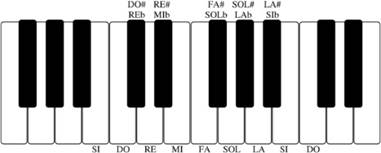
The C major scale, on the piano, is composed entirely of white keys. Easy, right? Play it a few times, first ascending and then descending. Sing it while you're playing it. Maybe you're not Bobby McFerrin but, if you commit enough, you'll see that you can hit all the notes without great difficulty. Also try to imagine singing the notes with your inner voice, without actually singing but using only your mind. You'll realize that it's much easier than singing because in the brain you don't have to also control the muscles of the vocal cords. Continue like this for a while: sing, then imagine singing until your inner voice can perfectly hit all the notes.
Now mix the notes somewhat randomly, always using only the white keys. Notice how some combinations of sounds are more dissonant; that is, they create a tension that you expect to be somehow resolved.
I'll give you an example: play the notes C, G, first one, then the other. Now play them together. The quality of this interval is consonant, that is, the two notes go well together and don't seem to create a tension that needs to be somehow resolved. This is a perfect fifth interval. If we numbered the notes in a sequence starting from C with the number 1, we would have:
- C
- D
- E
- F
- G
- A
- B
- C
That's why we say that C-G is a fifth interval: because it's found on the fifth degree of the major scale in the key of C. What does key of C mean? It means that we took the note C as a reference and built our sound system, in our case the major scale, starting from that note2.
If we analyze the intervals that separate the notes of the C major scale, we see that between C and D there's a tone, between D and E a tone, between E and F a semitone, between F and G a tone, between G and A a tone, between A and B a tone and between B and C a semitone. The constructive scheme of the major scale can therefore be summarized in the sequence:
- tone
- tone
- semitone
- tone
- tone
- tone
- semitone
Using this scheme, we can build the major scale in any key. For example, taking F# as reference, the notes of the F# major scale would be: F#, G#, A#, B, C#, D#, E#, F#. The fact that there are so many sharps is, alas, again a problem of ancient nomenclature, but let's not be fooled by the apparent complexity of the note names we're using: the major scale is still a major scale, and the relationship and internal simplicity of its sounds are identical to the sounds that we recognized as simple and familiar on the white keys of the piano. We've only changed the point of view and introduced quite a few black keys, but the internal relationships of the notes that make up our scale are always and exclusively based on two intervals: tone and semitone.
What I'm trying so laboriously to say is that, if you're able to sing a major scale, you're also already in possession of everything you need to recognize and reproduce the semitone and tone intervals. Maybe you didn't know what a major scale or a semitone was, but you already knew how to sing the material.
For each note of the major scale, we can consider the interval of each note relative to the previous one, as we just did. We can also consider the intervals between the note we took as reference for the key (C) and the notes found on each degree of the scale.
We'll see that between C and D there's an interval of one tone (major second), between C and E two tones (major third), between C and F two and a half tones (perfect fourth), between C and G three and a half tones (perfect fifth), between C and A four and a half tones (major sixth), between C and B five and a half tones (major seventh) and between C and C six tones (an octave).
Don't be scared by the names of things: so far we're only talking about the sounds of the white keys on the piano. All the complexity related to the names of musical concepts is due exclusively to the need to communicate an idea unequivocally. If I lived in an ivory tower, I would find myself in the unpleasant condition of having to explain to the Animal Protection, Customs and Tax Agency agents where I found so many elephants. However, I wouldn't have the problem of having to use six sharps in the F# major scale. I would give each of the 12 semitones in the octave a unique name, for example: AW, KA, WA, WE, OH, JOHN, etc. And I would be happy, at least until I was forced to come down from my ivory tower3 to convince someone to play my string quartet in Phoenician OH.
The exercise I propose now serves to better internalize the intervals of the major scale. If before we played more or less randomly with the white keys, now we'll examine the simplest intervals relative to the reference we gave ourselves, that is, the note C.
Starting from C, the first interval we encounter is the unison, that is, the note C followed by the same note. This shouldn't be a challenging interval to recognize because the pitch of the sound isn't changing, we're just inserting a pause between the first and second sound.
The next interval is C-D. This is an interval of one tone or a major second. Play the reference first (C) and then the interval note (D). These two notes are very close, and their sound becomes strange only when we play them simultaneously. Try to play C and D together: funny, eh? It's like something should happen. Listen carefully to the beats. Can you hear how what until a second ago we considered only two banal notes played together, now that you're paying particular attention, present a harmonic richness that's not banal at all?
If you follow the same procedure with the other degrees of the scale, you'll see that C-E (major third) and C-G (perfect fifth) are particularly consonant intervals (that is, they sound good), while the others are more dissonant in the context of our reference (which is the key of C major). The perfect fourth interval, for example (the note F), has a natural tendency to want to resolve on the major third (E), as if it were in an unfamiliar area and wanted to return home to be reassured. The same thing can be said for the note B (major seventh), which wants to move toward the nearest C.
Try and work on the intervals of the major scale, playing them first melodically (first one note, then the other) and then harmonically (two notes together). Always sing and use your inner voice when you do these exercises. You can't sing a harmonic interval (two notes together), but singing it melodically will help you distinguish the individual notes that make it up.
Your inner voice should instead be able to imagine the two sounds simultaneously. If you can't, first stop to think about the first sound for a few seconds, imagining maintaining it while you start the second sound. For some this mental exercise is more challenging than for others, so don't worry if you don't succeed immediately. Be patient, insist calmly and decisively, and you'll see that it will be possible for you to succeed.
When you've practiced long enough (where enough varies from person to person: sometimes minutes, other times months), you can try the next exercise which consists of giving yourself a reference (for example, you can play the note C) and trying to imagine what sound will come out by pressing another white key. For example, first I play the note C and sing it, then I think of the F key and try to imagine what sound will be produced by pressing the key. Then I sing the note I think is F, and finally I play it to verify that it's correct. Since you've previously practiced the major scale up to an octave, you should be able to imagine the sounds of all the white keys from C to C of the next octave. Also try changing the reference, that is, don't always play C as the first note: use a random one.
The exercise I propose now serves to verify unequivocally that you've internalized the major scale at an instinctive level. Generate some groups of numbers from 1 to 8. For convenience, I provide some example sets below, but you can generate as many as you want. Each set represents a melody and each number in the set represents the degree of the scale. For example, 2, 8, 1, 5, 6 would be D, C, C, G, A, where 8 would be the higher C, and 1 the lower C.
Set 1: 8, 7, 1, 3, 4
Set 2: 5, 4, 1, 3, 2
Set 3: 5, 4, 2, 3, 7
Set 4: 7, 6, 1, 8, 2
Set 5: 6, 5, 8, 2, 1
Set 6: 2, 1, 3, 4, 8
Set 7: 4, 5, 3, 8, 2
Set 8: 5, 6, 8, 7, 4
Set 9: 8, 5, 4, 3, 2
Set 10: 6, 2, 7, 1, 8
The exercise consists of giving yourself a reference by playing C and singing the melodies (the sets) represented by the numbers.
In this case you'll soon realize that it's much easier to imagine the sounds than to sing them. Intonation is going to be a problem only if you want to sing, believe me. For ear training purposes I can assure you that uncertain vocal intonation is not necessarily a symptom of poor understanding of a musical concept or melody. However easy it is for me to improvise a bebop phrase on the piano, singing it would be a whole other story because I've never practiced with my voice. I'm sure some of my friends would prefer to be crucified rather than having to hear me sing.
Once you've acquired instinctive mastery of the major scale, all that remains is to attack the black keys to thus complete the 12 sounds and enter the wonderful world of the chromatic scale: an idyllic world in which all intervals enjoy equal rights and consonance and dissonance are just old concepts to be relegated to the tonality boomers.
I have good news for you: the intervals that in the C major scale are represented by the black keys of the piano, are already present in another form within the same major scale. Let's examine them:
- the semitone interval (C-C#), the minor second, is present in the C major scale as E-F and B-C;
- the interval of one and a half tones (C-D#), the minor third, is present in the C major scale as D-F, E-G, A-C, and B-D;
- the interval of three tones (C-F#), the augmented fourth, is present in the C major scale as F-B and B-F;
- the interval of four tones (C-G#), the augmented fifth, is present in the C major scale as E-C, A-F, and B-G;
- the interval of five tones (C-Bb), the minor seventh, is present in the C major scale as D-C, E-D, G-F, A-G, and B-A.
Your task therefore remains to visualize each interval in each key. This is an exercise that, if you play an instrument other than a piano, you'll find invaluable to also do on your instrument; it will open the way to mental visualization of all the sound possibilities at your disposal.
My advice is to follow a nested cycle in which at the first level you iterate on intervals and at the second on the chromatic scale, starting from the lowest note on the instrument up to the highest note. I write it in pseudocode for computer scientists and then in plain language for human beings:
for interval in (2m, 2M, 3m, 3M, 4, 4#, 5, 5#, 6, 7m, 7M, 8) {
  for note in (instrument_range) {
    play interval from note
  }
}
For each interval included in the list, for each note included in the instrument's range, play the interval starting from the note.
A sane person has already understood that the complete execution of the exercise requires at least half an hour and patience inversely proportional to the time spent in the exercise itself (in other words: the more you practice, the easier it becomes).
If we give this pseudocode to a hypothetical musical computer, specifying the natural range of the saxophone, whose lowest note is B flat and the highest is F#, its execution would produce the following output:
play 2m from Bb (Bb-B)
play 2m from B  (B-C)
play 2m from C  (C-C#)
...
play 2m from F  (F-F#)
play 2m from F# (F#-G)
play 2M from Bb (Bb-C)
play 2M from B  (B-C#)
play 2M from C  (C-D)
...
An interesting variant consists in iterating on the circle of fifths rather than
on the chromatic scale. If you're wondering, in the interval symbols, m stands
for minor, M for major and # stands for augmented. I wrote the two notes of
the interval in parentheses.
An even more interesting variant consists in doing the entire exercise mentally, imagining playing your instrument. However, please be aware that I won't hold myself accountable in case the exercise makes psychiatric care necessary for you.
An alternative a bit more compatible with mental health would consist in limiting yourself to the major scale, always in the range of an octave, working on all 12 keys.
Naturally, in the real world, intervals are not limited to an octave. However, I trust that, if you've come this far, you won't have problems practicing on more remote intervals, keeping in mind that the octave is an excellent reference for jumps of, precisely, octaves. Also, the real world is not limited to the use of the major scale (fortunately, otherwise what a bore...), but in addition to the various modes (among which the natural minor scale also appears), you should become familiar also with the melodic and harmonic minor scale, with the diminished scale (eight sounds, semitone-tone) and the augmented one (six sounds, all whole tones). Keep in mind that there are three diminished scales: all the others can be traced back to a previous diminished scale but starting from a different note. The same thing goes for the whole-tone scale, of which only two versions exist.
For chord recognition the discourse becomes quite complicated, and I wouldn't know how to better help you except by telling you to mentally decompose chords into the intervals of the individual constituent notes. Train yourself to recognize first the triads of major, minor, augmented, and diminished families, then move on to seventh chords (to be clear, chords that reach the seventh) and so on.
You may have noticed that in all exercises I always use an initial reference. Relative pitch needs a reference from which to start in the analysis of intervals and differs from perfect pitch which can do without such a reference. Many people who know me say: «ah, you have perfect pitch». No, mine is relative pitch, because I need a reference to orient myself in the world of sounds. It seems possible to do perfect pitch training up to a certain age, and, in fact, many people with perfect pitch that I know are musicians who started very early as children. However, some recent studies seem to demonstrate that it's possible to develop perfect pitch even in adulthood. This doesn't mean that the analytical capacity of relative pitch is less important than that of perfect pitch.
Another important thing to keep in mind is that the brain learns better when it finds itself in the so-called learning zone. In other words, the exercise mustn't be so easy as to bore the brain but not too difficult as to discourage it. If, in this zone of balance between very easy and impossible, we occasionally insert an element of slightly above-average difficulty, the brain learns and internalizes more easily. Many learning methods have made this philosophy their own by also introducing gamification mechanisms; that is, for example, the exercise provides a score to reach and levels of progressive difficulty to overcome.
Today there are many software programs that can help us do ear training. I'd like to recommend one that's also the one I use daily. It's called My Ear Training. There's a rhythmic dictation functionality that I find very useful because the aspect of sound duration is often underestimated in groove building. Then there are exercises of both melodic and harmonic type, and for each exercise you can choose the difficulty. For example, you can start with third and fifth intervals, and when you realize you're ready, gradually add the more challenging ones.
Personal Notes
Here we enter more into the field of curiosity and anecdotes because I'd like to tell how and why I developed my ear. In other words, if your purpose was to inform yourself about how to improve your ear, you could stop here, and you wouldn't miss anything particularly important. If instead you've heroically resisted the text avalanche in this era when the attention threshold hardly exceeds the length of a tweet, well... continue reading.
When I was very young (we're talking about the '70s), my father kept his electronic gadget laboratory in my room. There also was a fabulous Ekosonic electric organ that he had obviously modified to add a synthesizer and, later on, also an electronic drum kit, both rigorously DIY (at the time a Moog cost as much as a house).
While I played in my little room, especially on weekends, I listened to my old man play the organ. I often happened to hear him while he tried to learn a new song that could be an old Neapolitan melody but also the latest hit by one of the singers of the time. Dad started by playing a note and, if the next one wasn't right, he searched for it by trial and error. The procedure, in the most complicated cases, could last even half an hour, but in the end dad managed to find all the right notes by ear. For the song's chords I heard him searching starting from the lowest note and, when he had found it, he proceeded to play its chord: a nice triad in root position. Later I would understand that it was really challenging not to get the right chord because for 98% of songs the possibilities are limited to major and minor chords.
In short, dad learned to play a decent number of songs, and I understood what his procedure was. At the time I particularly liked the melody of a song by Memo Remigi whose title and melody I've unfortunately forgotten, and dad, seeing me playing with the organ, thought of sticking numbers to the keys and writing the melody for me on a piece of paper in the form of a numbers sequence. He must have probably seen a Bontempi keyboard of those that were once given as gifts to children and had thought of replicating the Bontempi system on his much more serious Ekosonic organ.
Once I learned Memo Remigi's melody, I wanted to learn more and more songs, and dad naturally didn't have the patience and time to write all that stuff for me. Following his example, it didn't take long for me to begin learning music by ear on his organ.
When I learned to read and write, my parents thought of sending me to study piano privately. The teacher went with my father to a shop in Sora, and a week later a fantastic black lacquered Schulze Pollmann upright piano appeared in my house. Thus began my piano and solfège lessons. I was still too small to understand the importance of discipline. In fact, solfège was mortally boring, and the few things I had learned to play on the piano, I had learned more by imitating my teacher than by reading them in books. In short, saying I was a bad student would be an understatement. But I was happy because I had my piano and I could play the songs I liked by ear.
All this was fine until I started to encounter songs that gave me more trouble. I had started listening mainly to Pino Daniele and Lucio Dalla. There was always something in these songs that I couldn't fully understand. This condition of incapacity gave me physical discomfort. It was really a feeling of anger that I was having. When I went to bed at night, I spent a lot of time in the dark, imagining the piano keyboard and how it would be to play those songs. There were parts that, if I imagined playing them, it looked like they worked; that is, I expected that by pressing certain keys I would produce exactly those sounds. There were other parts that I didn't understand, and I had to stop. Then I tried to reason backwards, starting from the end of the song and going backwards. The next day I woke up and ran to the piano to see if the solution worked. Sometimes it worked, sometimes it didn't.
In short, I spent so much time practicing with the keys of my mental piano in bed in the dark at night that in the end I didn't even need the piano to verify if the solution was right or not: I simply played it in my head and, if it worked there, it meant it would work on a real piano too.
My ear developed because I couldn't have lived without it. If there was an advertisement on television with a strange interval, I could spend an entire day trying to decipher it on my mental piano. After all, the fundamental intervals can be counted on the fingers of one hand, and the music that surrounds us is composed following few and well-established harmonic rules.
When then in middle school I discovered jazz and understood that there was a world in which you can write your music by improvising it on the spot, well... there was the fatal infatuation that continues to this day.
A curious aspect of my ear is that I can't control it. For example, if I enter a supermarket and the speakers are blasting music, my brain automatically tunes in and deciphers it more or less in real time. It's not a process I can turn off, no more than you can stop looking at the title of a book on a shelf without closing your eyes. I think that is, the type of recognition that happens in my brain with sounds is the same that happens, for example, when we see an object: if I'm looking at a car, I know that object is a car, there's no way to unsee the car object without closing my eyes.
If I listen to a major chord, I instinctively know that it's a major chord. I may not know what key it's in as I don't have a reference. However, I'm certain of the chord quality because for my hearing the level of recognition is the same as that of sight towards a real, mundane object.
Not having a reference is not a disadvantage at all, quite the contrary. For example, if I find myself in a doctor's waiting room, I can decide to play All The Things You Are in C# minor in my head just to keep myself busy. Unless there's already music coming from a little radio. In that case, for example, I try to imagine each chorus of the song in a different key.
This doesn't mean my ear is magical. Quite the contrary. I know well that there's nothing magical in all the hours I spent in my mind with my piano. I also know that to transcribe a jazz musician's solo, I need the help of software programs that slow down and repeat audio on command.
Today I practice mainly in recognizing different chord qualities, intervals beyond the octave, and I try (without great results, I must admit) to identify and memorize random melodies with more than six notes.
If you've read this far, I thank you for listening to me and putting up with me. I hope I've convinced you that ear training is not an esoteric subject and that, if you know how to approach it, you can use it to your advantage.
Finally, I'd like to reassure my psychiatrist: I've never written a string quartet in Phoenician OH.
"Sun Bear Concerts", ECM, 1978, liner notes
My friend Johnny, a drummer, always told an anecdote about a village festival: a gentleman asked to have his daughter sing on stage and, when asked what key he wanted for the song, the father proudly replied: «the best one!».
Speaking of elephants and white keys, did you know that the white keys of the piano were made of ivory? Fortunately for our proboscidean mammal friends, today white keys are produced with a mixture of wood and increasingly eco-sustainable plastic materials.